

angst-ridden backstory
or, Why I Love the little-known Ghibli masterpiece The Cat Returns

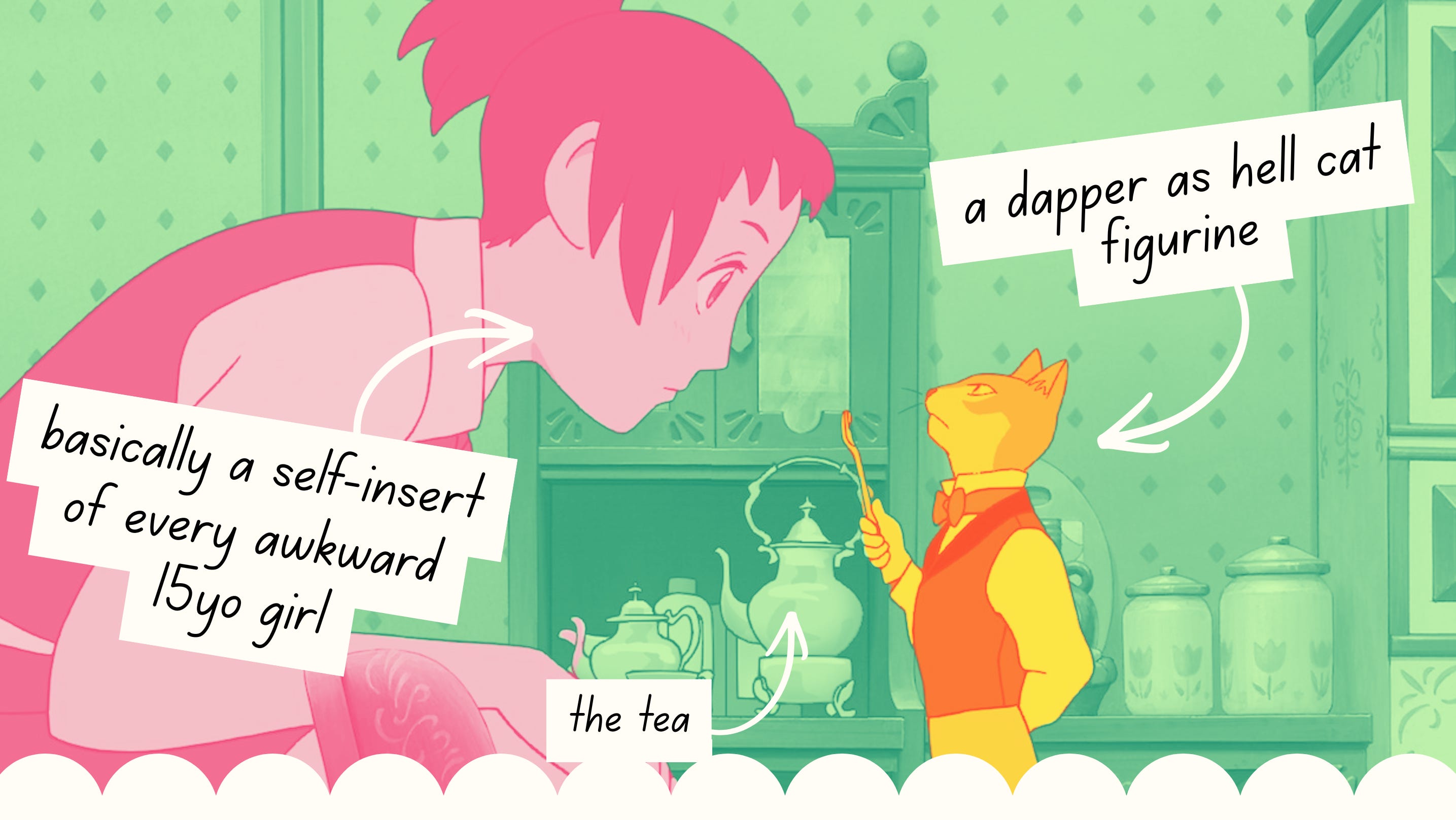
I think I was fifteen when I first watched The Cat Returns.
It was during the first “prestige” anime boom after Studio Ghibli had taken the world by storm with its exceptional Spirited Away, and a year after Howl’s Moving Castle introduced me to the magic and the wonder of my favorite author, Diana Wynne Jones.
So many of Studio Ghibli’s films have a soft spot in my heart. I love the fierceness of Princess Mononoke, the lyrical buoyancy of Porco Rosso (but especially it’s central thesis and one of my favorite quotes from the dub, “I’d rather be a pig than a fascist”), the quiet sweetness of Whisper of the Heart.
But it was The Cat Returns that became foundational for me—which is odd because, arguably, it’s one of the Studio Ghibli films that no one remembers. It isn’t directed by Hayao Mizayazki, after all, but unknown director Hiroyuki Morita, and The Cat Returns is his most notable work. Which… for one of Studio Ghibli’s films no one remembers… yeah.
For those of you who are unfamiliar with The Cat Returns, here’s the gist—
Bear with me. It’s a doozy:
The Cat Returns follows a high school student named Haru who, after saving a cat from getting hit by a truck (literal SAVE THE CAT!), finds herself bombarded by gifts from the Cat Kingdom for, apparently, saving their prince. Worse yet, the Cat King himself wants to offer his hand in marriage — a very magnanimous gift, obviously! He thinks its quite purrfect. Desperate to get out of this situation, Haru follows a (helpful) disembodied voice who directs her to the Bureau run by a lively cat figurine named Baron Humbert Von Jikkigen. He has dedicated his entire existence to helping those in need. And she is very desperately in need. What follows is a bit of catnaping, tomfoolery, masked ballroom dances, cat puns, labyrinthine mazes, Tim Curry chewing the ever-loving shit out of the scenery, and a bit of romance.
I can’t tell you why I love this movie so much. I’ve watched it both in Japanese and English, and honestly? I think it’s the English dub that has me—hook, line, and sinker. There’s something about the way it was translated, and the delivery of Tim Curry as the villainous Cat King, Cary Elwes as Westley from The Princess Bride But As A Cat In A Dapper Morning Coat, Anne Hathaway as the brave and charming Haru—
This film found me at the right time, in the right way.
And to me, it’s perfect.
Usually when I show this film to friends, excited to share my most favorite thing in the world, once the credits roll they always turn to me and say something like—
“I get you now.”
I’m currently listening to Disney Adults by AJ Wolfe.
It is, quite possibly, one of the most delightful nonfiction reads I’ve listened to in a while. Maybe it’s because I am a Disney Adult. (I have a popcorn bucket, I collect the passholder magnets, and I absolutely have multiple custom Mickey Ears.) Or maybe it’s simply because of everything that I associate with Disney.
From the theme parks to the thrill rides to the animatronics to the manufactured happiness (and the manufactured smells), I love it all.
There are, obviously, also parts of the Walt Disney Company that I don’t love. I don’t love the company’s blatant cash-grab when it comes to stories, favoring what will make the most money as fast as possible instead of anything that could be considered a slow burn. I also don’t like the alleged pressure internally to distance themselves from queer story lines. Or the way they’re rather trigger-happy with the cancellation button. (RIP The Acolyte, Willow, The Pink Ladies…)
But with that said, Walt Disney Studios is also the reason almost all of Studio Ghibli’s films are distributed here in the US through Buena Vista Entertainment. It’s the reason I ever found The Cat Returns.
So, my love is nuanced.
I think that’s the best kind of love to give a thing, if we’re being honest.
There is a part in The Cat Returns where Haru, after being catnapped by the Cat King and taken to the Cat Kingdom to be made his wife (I know), she laments that maybe life would be better as a cat. It would be simpler. Lazing about all day eat cat grass and taking cat naps . . .
It would be easy.
Haru could choose to stay in the Cat Kingdom and become a cat. She could let go of the clumsy, awkward girl she was, and never have to worry again.
But then Baron tells her to hold tight to the person she is—to believe in herself. To trust her instincts and her heart. That she, in all of her mess-ups and failures, is worthy.
What a novel thing that was for fifteen-year-old Ashley, nervous and awkward, too much and never enough, to hear. What a cornerstone of her making.
When she was fifteen, she was in her head a lot. By then, she already knew she wanted to write. Hell, she’d already written a 200k-word young adult reverse portal fantasy, determined to be the next Christopher Paolini or Amelia Atwater-Rhodes, even though her parents didn’t own a boutique publishing company and she didn’t have an English teacher who was also a literary agent. (I’ve learned that if something in publishing looks remarkable, there’s usually quite a few helpers in the background who are instrumental in that remarkableness. It doesn’t make the feat any less remarkable, but no one can build a mountain by themselves. No one ever has.)
She carried around a binder of her work, and she would edit it in class between assignments. But as her sophomore year progressed it became very obvious that she wasn’t going to write the next Eragon.
Maybe, she thought, I’m just not that good of a writer.
After all, the Governor’s School hadn’t wanted her for their creative writing track. They’d turned her down every year in middle school for the summer program, and then again for her high school audition—
So, she put that book away. She never finished it.
She felt like a failure.
I mean, in her head, she already was.
Her grades in English weren’t great, and she wasn’t the best at grammar. She was okay at spelling, but maybe that was because Microsoft Word yelled at her in swiggly red lines every time she misspelled a word. Clippy, toward the end, simply disappeared, having given up. (Or maybe Word had finally updated him out of the programming?)
And on top of all of that, fifteen-year-old Ashley was weird. Like, she bought bootleg subbed anime from China, and dressed in the dark on purpose, and wore plaid skirts over blue jeans, and cosplayed to movie premieres, and—for an entire year—wore a black ribbon around her throat to signify that she’d never been kissed.
Yeah, weird. (Affectionately.)
She daydreamed too much, and she still stuttered too often, and she cried whenever she got overwhelmed.
Fifteen-year-old Ashley was a weirdo.
And I love her for it.
I think, though, what I love the most is that when she decided that she didn’t want to be the next Christopher Paolini, she wanted to be me.
In 2006, [Title of Show] released a cast recording, and that year was the first time I heard the phrase, “I’d rather be nine people’s favorite thing than one-hundred people’s ninth favorite thing.”
And I decided to make that one line my entire personality.
While I never picked up my 200k-word reverse portal fantasy epic again, I started writing other things. I’d already burrowed myself deep into the fanfic trenches, honing my craft in the way only godless heathens on the 2000s internet could.
And the weirder I wrote, the more I loved writing and the more I loved writing for me.
There was a power in that. There was a lightness.
In the end, I didn’t care if everyone loved my stories, because I loved them. I was my own favorite thing.
There’s this quote from Field of Dreams that goes, “If you build it, they will come.” It’s meant to refer to a baseball field in the middle of nowhere, but I find it applicable to writing, too. If you write it, people will find you. Maybe not immediately. Maybe not at the most convenient moments.
But if you write what you love, someone else will love it, too.
There is a part toward the middle of The Cat Returns where the cat figurine, Baron Humbert Von Jikkigen (Baron for short), offers Haru some hot tea. It’s just after she’s come to him asking for help to break away from the terrible Cat King, who in a few minutes will send his minions to catnap her.
“That’s my own personal blend of tea,” he states as he hands her a cup and saucer. “It’s a little different each time, so I can’t guarantee the taste.”
She sips it and exclaims, “Wow! That’s the best tea I’ve ever tasted.”
“Then you’re lucky,” he deadpans.
And oh, isn’t that such a metaphor for art? For creating, over and over again, never quite knowing how to recreate the recipe that made people fall in love with your imagination to begin with? When I first watched the movie at fifteen, I didn’t quite understand the scene — not like I do now. I understood it, but I didn’t understand.
Not until I was a little (well, a lot) older. Not until I started writing as a career, really.
You see, the teenager who dreamed of writing the next Eragon never actually wrote the next Eragon, but she grew up to write the first Geekerella. But that’s not the book I want to talk about.
The one I want to talk about is the book that came after Geekerella. In 2018, Balzer + Bray (then with HarperCollins) published Heart of Iron, a story that had been so dear to my heart since I was that fifteen-year-old dreaming of having her books on the shelves of her local Books-A-Million. I loved that story of a lost princess and the metal boy who would destroy the universe to save her. I loved every trope in it, every character, every terrible choice the characters made—
It’s messy, but I still love it very, very much.
It was my own special blend of tea, you could say. I figured that since most people loved Geekerella, they would fall in love with Ana and Di too but—
Well.
It was my own special blend of tea, you know. It’s different every time, so I can’t guarantee the flavor.
And it was very clear that some people did not like the flavor at all.
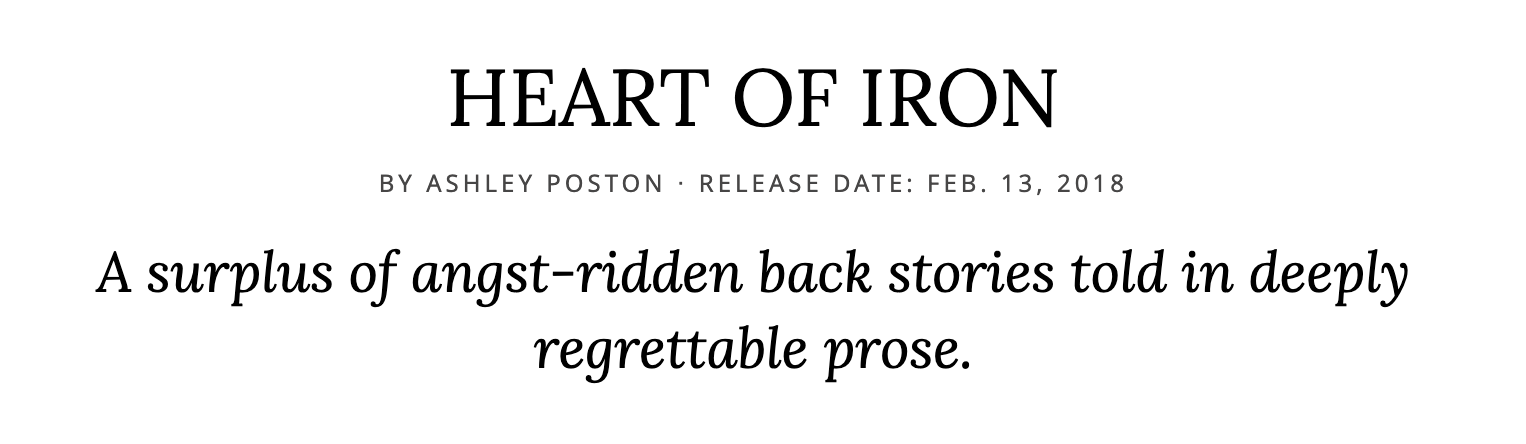
No one had ever called my prose regrettable before. I didn’t even think my stories were all that angst-ridden, at least not any more than other YA at the time.
Just two days after that professional, public review went live, Heart of Iron received a star from the BCCB, but of course that review has been lost to the internet. The one from Kirkus is obviously still up.
No one really tells you how to react when you are humiliated in front of your peers, so I did the only thing I knew how to do: I kept writing. Most because I wanted to prove that the review was wrong, that I did not have regrettable prose, that my backstories weren’t angst-ridden—
But time and distance makes molehills out of mountains.
And the truth is?
I think my backstories might actually be angst-ridden.
I think that sometimes I do lean towards pretty purple prose.
And I think I like it.
What I write might be imperfect, and so my stories will be a little different every time — much like Baron Von Jikkigen’s tea — but that’s what makes it lovely, to me. That’s what makes me want to keep writing, because in all the angst and backstories, I find new flavors.
Each time I tell a story, I can’t guarantee that it’ll be your favorite, but I can guarantee it’ll be a story a little different than the last.
Because I will be a little different as the one telling it.
I have spent years embroidering pillows with Angst-Ridden Backstory and I’ve marred many notebooks with the Deeply-Regrettable Prose, even though my books have appeared on New York Times’s Best Books of the Decade, and People’s Best Books of the 2020s. My adult debut was a Good Morning America Book Club pick. I’ve sold over a million copies of my novels in English alone, nevermind internationally. But still, that stranger’s words lives rent-free in my head.
And honestly? I kinda want to thank them. Angst-Ridden Backstory and Deeply-Regrettable Prose have sort of become my mantras, reminding me that not everyone will like my stories, but they also don’t have to.
I like them.
The fifteen-year-old girl obsessed with anime and dressing in the dark likes them.
In the end, she’s the only person I need to impress, and I’ve already done that.
At the end of her adventure, with her heart still pounding, Haru embraces her awkwardness and confesses that she might have the smallest crush on Baron. She doesn’t say it hoping that he returns her feelings, she just wants to share her decidedly truthful, messy, and imperfect self.
And in return, he gives her the kindest gift: a rejection.
He pats her cheek and says, “I appreciate a young woman who speaks from the heart.”
She doesn’t crumble. She doesn’t cry. She smiles and she waves goodbye as the crow, Toto, carries Baron away on his back. (I’m telling you, it’s a weird movie.)
In the final scene we see Haru with a new haircut, having gotten up early to cook breakfast for her mom, who is thoroughly impressed. As Haru heads out the door she tells her, “I’ve made some tea, too! By the way, that’s my own special blend of tea. It’s a bit different every time, so I can’t guarantee the flavor.”
In the end, it’s not in the reception of the art that’s fulfilling—at least, not for me—but the act of making it, and the act of inspiring others to make their own, too.
Because the things we create, the art and the books and the movies and the video games and the music, will keep changing as we change. We’ll craft new things, try different methods, use different mediums —
Each book’s a bit different every time, so I can’t guarantee the angst-ridden backstory told in deeply regrettable prose.
And if you like it?
Well, you’re lucky, then.
So glad you never gave up and kept writing. For what it's worth, you're my very favorite author and I have LOVED every single one of your books (including the one with the review of supposedly "regrettable prose") and I think what I love most about them is their "weirdness"--that something that's just a little different than the norm. It's my favorite thing. So thank you for your work and for writing things I love.
I think we need deeply regrettable prose on baseball caps x